January
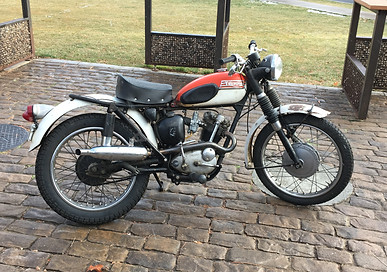
1966 Triumph T20SM
Mountain Cub
By Jim Meadows
Bikes of the Month 2019
Smokey the Wonder Cub
"Smokey" is a 1966 Triumph T20SM Mountain Cub sold new by Bill Rudd Motors on Gentry Way. However my Triumph was built by BSA. The late cubs, identified by the engine number being stamped on the left side of the crankcase below the cylinders, were built at Small Heath. The cubs built at Triumph have the number stamped on the front engine mount. To further confuse things, duplicate serial numbers were used and apparently 'Smokey' is one of those with a twin somewhere with the same number. Huh, I guess a cub single can be a twin too.
In the early 1980's I traded a plunger framed cub to Mike Hammond for 'Smokey'. He wanted to build a vintage trials bike [the plunger cubs compete in the rigid class against the rigid 350's and 500's, that doesn't seem fair]. I wanted a cub for my daughter to learn to ride on, the swing arm model I thought would be better and the mountain cub wasn't as severe a project.
Mike had the paperwork from the tow company auction where he bought the bike. It had been abandoned in an alley
I set about trying to make it run. The electrical system had been messed about with, as I recall the primary cover and alternator were off. The mountain cub was a derivative of the trials cub and used an "Energy Transfer" ignition system to save the weight and complexity of a battery system. It wasn't known for dependability when new and in the early 80's parts weren't available for the 'ET'. I don't know if they are now. It uses a different stator, coil and only a 4* advance mechanism. I put in an alternator, coil, advance plate off a Commando and a "Mity Max" battery eliminator because that's what I had. Norton parts made it go.
Daughter learned to ride, operate the clutch and shift, grew up and moved out. I started to ride the cub around town and even over to Downieville once. Well heck, if it'll make it to Downieville [and back!] I might as well take it down to the BSA club 'All British' ride. So I did, just to show that you don't need a real 'road burner' to go 60 mph on an 80 mile ride.
I got to practice coordinating the front and rear brake going down a bunch of switch backs that ended at a stop sign at Highway 1, and was able to roll through the stop with out any harm. Those 5" stamped tin brake drums have their limits, but they are anti-lock so they must be safe. I adapted a 7" twin leading shoe front brake off a Honda 350 and sent it to Vintage Brake for new linings and arcing. Now a shorty lever will make the front wheel howl. Honda parts make it stop.
Since I was was riding it I ought to bring it over to the 'right side' of the law. At the 'All British' ride it's a contest to see who has the most expired license plate [last year there was a '59] but around town you don't want to get that award. I've got the paperwork of a Nevada auction from 20 years previous, what could be wrong? At the DMV when I pointed out that the year model of 1979 wasn't accurate, the plate was expired in '77 and the serial number meant it was a '66 the gal pushed my paperwork back "Take it back to the tow company they'll have to re-auction it" That didn't sound like a good idea to me.
That was before my brother Jerry found out about the Sparks court order way of getting the DMV to issue a title. I know someone who owns a tow company and she has a way of getting a title. They have to have possession of the bike, it takes 3 months and cost $300, but it worked.
By then I'd had the bike over 20 years, it goes, stops and it's legal. It was time to do something about the clouds of blue that followed it around. 'Smokey' is a nickname earned honestly and it's a 'wonder' that it never fouled a spark plug.
One winter I pulled the top end off [it's all of 9 screws] and sent the cylinder out to be nickasil plated, put in a new piston and lapped the valves. Wow, no more smoke! I was so happy I bought a new concentic carb. The monoblock didn't idle right when the bike was on the side stand, it leans over quite a ways and the float chamber being off set to the left causes it to stall, although it would idle fine if you held it upright.
I rode around town to break it in and up the hill on McCarran Blvd. [WFO!] to check the jetting. All ok!
That November, 2014 I think, I hauled it down to the 'All British' for the 4th or 5th time. A couple of miles out of town at the first bit of full throttle, and you ride a cub full throttle a lot, the engine quit. No compression. Oh _ _! I guess it was too lean at sea level. I got the 'hard luck' award, another one you don't want.
Well the bike sat around a while, this is a long term project after all. Last fall I pulled the top off again. Yep the piston was scored and the rings were stuck, there was aluminum all down the cylinder. The plated cylinder cleaned up fine and I had a new piston. A couple of gaskets and it was running again. I put on a Boyer battery eliminator, smaller and so far better than the Mity Max. I also built a better engine breather system I hope, we'll see. Gotta get some larger carb jets and I've got an electronic ignition to put on.
The late Paul Harvey told a story about being in Italy on Vacation. He and his wife, Angel, visited a foundry where they cast great bronze cathedral doors. There was a fellow filing and sanding and polishing one of those doors. Paul asked him "how do you know when it's done?" He replied "It's never done, they just come and take it away." Smokey's kinda like that, it'll likely never be done.

February
1937 Indian Chief
By Rick James
In 2005, I was looking for a mid-30's Indian Chief and found this one in Truckee, CA. The engine was off and apart in Truckee, the bike itself was in Peter Hipp's outside shed in Reno. The correct term for it was a "bitsa bike". I soon learned that over half of the parts on it were incorrect. Harley handlebars and seat, Triumph wheels, lots of wrong year Indian parts, etc. This began a 9 year restoration that was a journey in itself. I did most of the mechanical work. I learned to paint PPG basecoat/clearcoat on this bike, the green was custom mixed by me. "Real Ralph" Newman did the gold pinstriping, a true artist. Any parts that were incorrect were sold to finance the purchase of the correct parts. My learning curve on this bike was steep.
I chose a mid-30's Chief for several reasons. Since Indian had incorporated recirculating oil in 1934, this bike had it. There are reproduction parts available from several suppliers. Although I like the '40 and later skirted Chiefs, the mid to late 30's bikes were a beautiful art-deco style that I liked the best. I finally completed the project in 2014. Since I had never ridden an Indian, the first ride was hectic. I soon learned how to survive modern traffic with an old bike that had a foot clutch, tank shifter, a three speed non-synchro trans, and lousy brakes.
I was unprepared for what came next! Cameras, cellphones, thumbs-ups! I couldn't avoid a crowd wherever I parked it. Kids leaning out of the school bus windows, other bikers doing double takes, etc. Riding this bike to a place where there are dozens of Harleys draws lots of interest.
I joined the AMCA and showed the bike at the Dixon, CA meet, see photo. Later I joined the local Comstock Chapter in Reno, NV and I'm enjoying meeting new folks, learning about other bikes, and riding to various locations.


Dixon Show - 2014
March
1971 BMW R75/5
By George Canavan
BMW motorcycles have always offered a strong interest for me going back to the 1970’s and my first purchase - a well used 1960 R50/2. With 109,000 miles and a few accidents from new, it proved to be the perfect entry bike for the horizontally oriented motoring fan. We commuted rain and shine for a couple of years free of drama or incident.
After a couple of decades of four wheel family life, it was time to return to vintage riding. The choice was obvious, another R50/2 which led to a R69US. The US model was a stop gap model as the product line was being revamped to address modern riding styles and hip 70’s design elements. The US models returned to telescopic forks indicating a move from sidecar toting to a sportier chassis to come.
When the product planners decided to abandon tradition and move into the swinging 70’s they did it with wild abandon with the introduction of the Slash Five models. Gone were the oval tube elements with side car lugs, the Earles forks, the heavy duty gear box, oil slingers and roller bearings.
High pressure plain bearings and oil filtration were introduced as well as electric start, upgraded Bing carbs, a smoother automotive style four speed transmission, lighter frame elements with a separate rear structure and upgraded wheels and brakes. Top of the line engine capacity was notched up to 750cc. Gone were the staid color options of either Avus Black or Dover White. Granada Red, Metallic Green, Monza Blue, Polaris Silver and Curry Metallic met the market with a brave new face. In order to attract the swingers of the 70’s who were eyeing large bore bikes from Asia, Bavaria turned to chrome ladled on with a trowel. Hence the “Toaster Tank” moniker for the new design.
Our satisfying experiences with Slash Two BMW’s led to the interest in experiencing some of the benefits of these Airheads first hand. The Slash Fives were of most interest as they still had drum brakes, the now vestigial kick starter and the short wheel base. While Toaster Tanks were usually avoided by the purists who choose the larger slab sided tank without the chrome adornments, Toasters are now tolerated as a period design element.
eBay day dreams soon led to action as we zeroed in on a likely suspect. Toaster tank, check; funky color, check; 750cc, check; extensive maintenance file, check. There were enough things that felt right to pull the trigger so we did and had it shipped from North Carolina.
Upon arrival, the work began. Early short wheel base Slash Fives have earned a warning about not overloading the chassis as handling mysteries could be expected. The wind screen, panniers and top case were removed. Squared off Dunlop K 70 rubber was replaced with modern profile Avons. Worn rear shocks got pitched and the drive shaft renewed. Head bearings were removed and replaced too. All part and parcel of the handling package that needed to be addressed for safe and reliable touring.
Our R75/5 has been on the initial Reno Rough Rider Tour, the 19th Borrego Winter Road Run and several other tours both solo and two up free of drama or incident. It returns about 50 mpg, handles crisply and is fun to ride enthusiastically. Compared to a Slash Two or the later R100’s, the handling is more like a 450 dual sport. In all, an interesting addition to the riding experience.


April
1968 American Indian
Super Scout
By Jim Meadows
My 1968 American Indian “Stroker” Scout was the first motorcycle that I ever purchased. My brother and I were raised on a ranch in eastern Nevada and I moved to Reno after high school to attend the University of Nevada, pre-UNR. After a while, about 1972, it was time to buy a motorcycle.
Our cousin lived in Santa Cruz and had a Triumph Daytona 500 that he had purchased new! He knew of a hippy living in the Santa Cruz Mountains that had two motorcycles for sale, a Triumph Bonneville and an Indian Scout. I didn’t know much about Indians, only that they were made in America and that they were no longer being produced. The two bikes were parked outside and were starting to rust a bit, “Five hundred dollars, your choice”, the hippy said. I bought the Indian.
The story was that the Scout was put together in Los Angeles, and the first buyer returned it because it vibrated too much. My cousin hauled it to Reno in his El Camino and I had a bike to ride. I remember a small fire on the handlebars when the dimmer switch shorted out.
After some time, I took it apart over the winter to clean it up and replace the paint. I replaced the front fender, which was a rusty, cracked chrome accessory type of thing. Someone in Oakland had a bunch of new BSA parts and a new BSA Rocket 3 fender was purchased. The rusty stamped tin license plate/taillight mount also got replaced. Over the first couple of years, the Autolite generator quit every summer so it was replaced with a VW Bosch unit. Other than the fender, license plate mount, and generator, paint and wiring, it is pretty much as it was when I purchased it in 1972. Oh, the baffle in the muffler came lose on a ride somewhere close to Sonora once, so that got replaced too.
In the summer of 1967, July, my then wife and I, along with Jerry and Patti Meadows and Ray and Pam Horstmeyer were motorcycle camping off of Highway 49. The following April, I became a daddy. You do the math. The wife is gone, but I still have the Scout and the daughter.
So about this bike that I have been riding for the past 45 years or so. In 1968, Sam Pierce, AKA Mister Indian, had an Indian parts business in Los Angeles, San Gabriel I believe. He had bought up Indian parts all over the country to keep those old Indians running. He had enough parts to assemble about 109 motorcycles, the American Indian Super Scouts.
The Super Scouts were known as “American Indian’s”, to avoid any quarrels over the Indian name, which I think was claimed by Floyd Clymer at the time. Floyd was importing and selling Indian badged English, Italian and Taiwanese Indian’s.
All Super Scouts had Scout v-twin engines in a postwar Warrior chassis. I have read that the factory assembled one or two prototypes of this configuration. Pierce’s Super Scouts were built in four sizes:
-
30.50 cubic inch (500cc) with a 741 military Scout engine
-
37 cubic inch (650cc), a 741 military Scout engine with Indian 4 pistons
-
45 Cubic inch (750cc) with a Scout engine
-
57 cubic inch (934cc), a 45 ci Scout engine with Chief flywheels
Mine is a 57 incher with a 2 7/8” bore and 4 ¼” stroke. It does vibrate a bit. After a year of riding it on the highway, I would have to replace the mirrors because the silver would fall off.
All of the Super Scouts differ in details, like tanks and seats. I have seen a 30.50 with a girder front end, but most have a Warrior fork and brake with a 741 rear wheel. Mine is equipped with a “peanut” tank, “cobra” seat, suicide clutch and jockey shift. As far as I know, all have the unique aluminum cover on the right side of the engine and the custom made casting to drive the generator from the back of the primary cover, like a Chief.
The defining point is “AIMCO”, American Indian Motorcycle Company, on the engine casting. The serial numbers are two digits for the year, two digits for the engine size, and two digits for the build number. My Super Scout VIN number is 685725. I was told that only twenty-seven 57 inchers were built.
The July 1969 issue of Cycle Guide magazine, which was reprinted in the July 1996 Walneck’s Classic Cycle Trader, has an article on Sam Pierce and his business. It says he would build a new Scout for $995.
The second motorcycle I ever purchased was a 1958 Ariel 650 twin that I gave to Jerry. I also paid $500 for the Ariel. Jerry can tell you about it.

Jim Meadows and American Indian Super Scout
The 1 Moto Show , Portland, Oregon, 2019
May
1972 Triumph TR6RV
By Jerry and Patti Meadows
Anatomy of a Restoration
This is an accounting of what it takes for me to restore a pile of excrement into a bike worthy of its heritage and all the additional help along the way.
This motorcycle was rescued from one of the sheds at Phil Anderson’s ranch after all buyers had passed it by. It was mostly complete but needing lots of TLC. I went through Sparks Justice Court to obtain a title.
I completely dismantled and inspected what was and wasn’t there. Because this is an OIF (oil-in-frame) model, it is not yet a desirable piece, so I took some liberties in the restoration. I had the frame and swing arm powder-coated flat black. I replaced the drum brake with a newer style Triumph disc brake front end.
There was no wear or damage in the engine that would give me an idea as to why this bike was parked. I had the crank balanced using the original standard-bore pistons that were Swain coated. I was also able to use the original valve guides with new valves, springs and valve seals. I installed the existing 5-speed gear box. All aluminum cases are polished by me while watching movies in my shop. With a new carburetor and electronic ignition, the motor unit is set aside.
New rims and tires installed to make a rolling chassis. Later year front and rear fenders were de-chromed, holes filled and massaged for fit as needed. I found an OIF gas tank and had it stripped, boiled out and pressure tested. British racing green metallic paint with white accent stripe and black pin-striping was chosen for the tank and fenders.
Original exhaust pipes were re-chromed (because re-pops just don’t fit) and matched with ‘60s-retro Triumph mufflers. I replaced the ugly DOT-required taillight from the 70’s with a sexier 67 taillight. The side panels were painted a gloss black as were all other bolt-on parts, headlight ears, etc.
Fitted new cables, carb and instruments. Had a factory seat cover installed over new foam.
I kicked the engine through to circulate the oil, only to find one of the only parts not be replaced, polished, painted or plated to be bad - - the oil pump. So even before starting, the first part to be replaced under the unlimited lifetime parts and labor warranty was the oil pump.
As I write on Sunday night, the bike is scheduled to be started on Wednesday morning. And I have to thank the following people for making this restoration possible: Al at Accent Auto Body for all metal repairs: Altizer Powder Coating; Bob Hayes, machinist extraordinaire: KAR upholstery: Meclec Metal Finishing; Tom Kith paint and pinstripe: Apex Anodizing for zinc plating.
Wednesday morning came before this was sent to Rodd. The bike started on the first kick, what a thrill. Timed it and took it for a 20 mile ride. Unfortunately, the alternator is not alternating, so the warranty work begins.
You can see, without the help of my friends, this restoration would not be possible.

June
Sonicweld 500 Triumph T100R
By Rodd Lighthouse
My bride has made some ridiculous accusations about me, or has she? She once accused me of building a motorcycle because I had acquired a throttle cable for a specific bike. Ridiculous, right?
Some time in the 1990’s a gentleman gave my father a Sonicweld dirt track rigid frame. The gent said it was for a Triumph engine. Upon telling me of his acquisition, I was stoked. Since childhood, I have been fond of dirt trackers, especially rigid frame dirt trackers. My father raced one and I wanted to be like Dad. Seeing my excitement, Dad gave me the frame and threw in some 500 Triumph motors that he had lying around collecting dust. I immediately checked out the donor’s claim and determined that the Triumph engine wasn’t the same as the motor that was in the frame prior to receiving it.
The project sat around for a couple of years while I came up with a plan. Approximately 2001, while working on an Indian Casino project in Coarsegold, California, I took advantage of my geographic location, and took the frame and engine cases to Valencia, California to Tri C Engineering, the company producing Trackmaster Racing Frames at the time. Tri C fabricated front engine mounting plates and rear engine mounts to fit the Triumph 500 engine into the frame. Again, the project sat around for a while.
Approximately 2004, Dad and I attended the vintage Sacramento mile to check it out and see if it was something that we wanted to do. The racing looked fun, which against our better judgement, stimulated us to build dirt trackers for the race the following year. Fortunately, the vintage Sacramento did not take place the following year because I did not get the bike completed in time. I did however continue working on getting the bike together in hopes of eventually getting to race it.
I set about putting an engine together and gathering parts. Hot cams were ordered from Megacycle and high compression pistons were purchased from a local shop. Heavy-duty valve springs, new valves, and new clutch plates were also purchased. Thirty millimeter Amal carbs from a modern 750 Triumph were acquired through a want ad and rebuilt. Cylinders were bored and cylinder head was given a fresh valve job. Dad worked his magic on the ports and built manifolds to mount the carbs. A special friction reducing coating was applied to the pistons by Swain Tech Coatings, as well as a heat emitting coating to the cylinder and cylinder head. New bearings, gaskets and seals completed the engine work.
In addition to the engine, a significant amount of time was spent sourcing chassis parts such as Barnes spool hubs, shouldered aluminum rims, stainless spokes, Goodyear dirt track tires, rear sprocket/s, solo seat, pillion pad, aluminum rear fender, and Ceriani forks. I wanted the bike to look like a legitimate dirt tracker from the brakeless era of dirt track racing, pre-1969. Engine and chassis parts were cleaned up, painted, polished, and plated, prior to assembly.
Starting with a Sonicweld frame and an assortment of 500 Triumph engines, I was able to build one of my favorite motorcycles, a Sonicweld 500 Triumph. As it turns out, my wife’s accusation wasn’t so ridiculous after all.
In 2011 I finally got my chance to ride the Triumph on the Sacramento mile. The Triumph ran good and although the mile was intimidating, I got much faster throughout the day and ended up getting a third place finish.

July
1914 Indian
By Charlie Stewart
I replied to a “for sale" ad in Cycle World magazine for this Indian. I had no intention to buy an old motorcycle, but the area code indicated it was close by and I wanted to see an antique motorcycle up close. My interest was sparked and after a couple of weeks I phoned the owner back to see if the Indian was still for sale. No one else had called, so I took a chance and went to make the purchase. It couldn’t be started as '14 kick starters are very weak. This one was MIA. With help from friends a 1915 kick starter was obtained. The front forks and fender are also ’15, but from the matching patina they have been on here from very early in its life. It still had the original Indian spark plugs in it when I bought it. I rode it many years on the pre ’16 rides with the original 2 speed transmission and “tomato can” carburetor. The rear springs are a definite improvement over a rigid frame.
This ’14 Indian would have cost $275 new. It sports a cradle spring frame with a left hand throttle. It is rated at 7 horsepower. Added features are a Warner magnetic speedometer, belt driven generator for electric lights, a frame mounted Indian tire pump and tandem saddle. Also, on the top toolbox is an inclinometer.
Erwin G. "Cannonball “ Baker used a similar model to set the transcontinental record that year of 11 days, 12 hours and 10 minutes.


August
1981 Ducati Super Darmah
By Jeff Park
A few years back my wife asked me what I wanted for my birthday. I thought about it and answered “A Bevel Head Ducati”. After the shock wore off, she told me the price point, and then said “find one”. After about a six month search, I found a 1981 900 SD Darmah on eBay in my price range. I watched it for a couple of days, then one evening after a couple of beers I put in what I thought would be a low bid. Three days later much to my surprise my bid was accepted.
The original owner had decided it need a restoration so he took it apart, put it in boxes where it sat until a Ducati mechanic from Portland Oregon acquired it. He kept it around for about 3 years and finally decided it was time to rebuild it and make it a reliable riding machine, one that he would want to have for his own.
I got original paper work, and photos and receipts for all the work that was done. So far other then some minor issues it has been a fairly reliable ride.
According to the original paperwork I have, the bike was sold new in December of 1983 for $5500, there was a 1981 Yamaha XS1100 Special that was traded in for $2100, so the total paid after dealer prep etc. was $3967.
I have researched production numbers for the 1981 SD Darmah. From what was stated in the book, The Ducati Bible by Ian Falloon, the total production for Ducati 900 SD Darmah for 1981 was 683 bikes. Of those, 376 went to Australia, so that left 307 for the rest of the world.

September
1946 Harley-Davidson FL
By Mark Lobsinger
How I Got a 1946 Knucklehead
To start, here’s a picture of me on my 1946 Harley Davidson FL knucklehead……….well, sort of. My 1946 knucklehead actually started with a 1949 panhead. A few years back, my friend Napa Dave (Comstock AMCA member from Independence, CA) told me to swing by and check out a Harley 45” motor for sale, here in Carson City. The owner’s name was Louis, and I believe a few of you know him. Anyhow, I walked into his garage, and there on the floor was a Harley G-motor (servi-car). I looked at it for about 3 seconds before I saw what looked like a knucklehead motor in the back of the garage, peeking out from behind some shelving and a snow blower. Needless to say, I spent the rest of my time there inquiring about the knucklehead situation rather than asking questions about the 45” motor (sorry Dave). Louis had a complete 1946 motor, frame, and transmission buried along with some other “chopperized” parts. He indicated that he acquired the stuff years before, but really didn’t have any plans to sell it. I left that day without a knucklehead or a flathead motor.

Fast-forward a couple years-ish. I had just finished this 1949 FL bobber and was starting to put a few miles on it. I was really enjoying riding the pan, but had thoughts of selling it in order to fund a possible knucklehead project. I have another 1949 FL so I knew I wouldn’t feel too bad about letting this one go. I decided to text Louis and see if he still had his knucklehead, and if it was for sale yet. I think our text conversation went something like this:
Mark: “Hey Louis, Mark here. I’m friends with Napa Dave down in Lone Pine. I came by a couple years back to check out that 45” motor. Any chance you still have that knucklehead basketcase? If so, is it for sale?”
Louis: “No.”

I took that as a sign that it wasn’t meant to be, and didn’t lose any sleep over it. Besides, I was really enjoying riding the new ‘49. A few months passed until one day I ran into Louis at the grocery store. We naturally started talking about motorcycles and I told him I had finished the panhead bobber, but was thinking about selling it in order to fund a knuck. He said that he would love to have another panhead one day. He bought one right out of high school for $400 and rode it around for a few summer months before getting his Vietnam draft notice. According to him, all of his buddies were heading over to Vietnam and not coming home, so he decided to sell the panhead for $500 and at least enjoy the money. I told him I’d ride over and let him check out the pan.

To make a long story short-er, we eventually struck a deal on a trade. I think both Louis and I were equally excited. I was feeling really good about the situation until my wife saw the pile of old rusty oily parts sitting in the garage where my nice panhead used to sit. I think I quoted a forest for the treesor diamond in the roughidiom, but I think she confused “idiom” for “idiot.”
Fast-forward a year and a half or so, and I had the 1946 up and running in a semi-bobbed version. I was running black panhead tanks and speedometer, a 21” front wheel, and a small solo sprung seat. I had plans on making it more stock, but had not yet acquired the tanks, front fender, correct speedo, etc. yet. I threw it together with what I had. I asked my 3-year old son what we should name the knucklehead and his first response was “Reggie.” I got harassed pretty good when I told my riding buds I was riding Reggie, but they eased up when I told them the story. I rode this version on a few long rides, most notably a 10-day camping backroad journey through Northern Nevada, Oregon, and Northern California.


This past spring I finally got a stock set of tanks, a front fender, and a pogo seat in order to get it to where it is now. The left side tank is an OEM ‘41-’46 tank but the right is a side valve tank that I modified to clear the motor. I grafted in the bottom from a panhead tank. It turned out really well and you’d really have to know your pan/knuck tanks in order to tell. I also painted the tanks patinastyle to match the rest of the bike. It’s super hard to fake natural patina, but I really like the way they turned out.


The most exciting part of my bike so far has been the addition of a sidecar. I’m friends with this Greek who has an antique thing or two. One day, while we were in his garage eating gyro’s and drinking Budweisers, I mentioned I was looking for a sidecar to putt my kids around in. Just so happens that he had one, and we struck a deal. I built the seat frame for it and had a friend upholster it with some nice leather that fellow Comstock AMCA member Kelly Hogan donated. It turned out great, and my kids love riding in it.

I’ve put around 5,000 miles on Reggieso far, and plan on riding it a whole lot more. One of the coolest trips I did was taking my boy down to the Born Free Show this summer. We trailered the bike down to Southern California and then rode into the show, through about 15 miles of twisty canyon road. Riding in on the first day we hit a rain storm and a swarm of bees doing about 60mph. He loved it. When we pulled in they told us to park in the invited guest corral right up front. We had a great time, and I think he’ll remember it forever. I know I that I will.


October
1970 Hodaka Super Rat
By Steve Brizendine
This Hodaka Super Rat was built in May of 1970. I bought it from Lowell Boyer at Nevada Cycle Sales in late July of 1970. I walked into the shop which was an old-time motorcycle shop with cookie sheets under all the English bikes. The Rat was on the showroom floor next to a Greeves Challenger. Lowell walked out of the office and asked if he could help me. I said yes, I’ll take that one pointing to the Hodaka. He said how would you like to finance that? I replied ‘like this” taking a wad of hundreds out of my front pocket. I got out of the shop $425 lighter.
My Dad picked up the bike the next day with his pickup. He called me at work later that day and told me he had some bad news about my bike. He fell out of the pickup unloading it at home. He tried to minimize the damage by letting it fall on him. It had a small dent about the size of a quarter in the top of the tank. My youngest son asked me at the See See show in 2018 when I was going to get that dent fixed. I told him he could do it after he inherited it because I wouldn’t.
The only things I changed were the hand grips. I cut them off before I even rode it for the first time. I replaced them with flat track grips. I also installed a Webco front wheel spacer because it looked racier than the stock one. I removed the stock knobby tires (which I still have) and replaced them with a Pirelli MT53 on the front and a Dunlop K70 on the rear. That was the set up that worked well for most flat tracks. I did the gold leaf on the air cleaner cover over the stock decal because I was learning how to do it and it seemed like a good place to try it.
People have asked me if I ever rode it because it is in such good shape. It was ridden hard almost every day for 2 summers. It was my practice bike. I had a Hodaka flat tracker that I rode at the indoor short track at the fairgrounds. I fell off the Super Rat almost every time I would ride it. Mostly low sides. “You never know how fast you can go until you fall off. “I have also been over the handle bars a couple of times. Once when I rode it into a drainage ditch next to a dirt road in 5th gear and once when I hit the strongest sagebrush in Nevada also in 5th gear.
The forks have been bent and straightened. The original number boards turned yellow from the sun and the front one broke from vibration and were replaced. I bent and replaced the front fender with a stock replacement. The shifter springs were also replaced (a common Hodaka ailment). That 19-year-old 145lb rider wasn’t always easy on the equipment. It was raced a couple of times when I was waiting for replacement parts for the flat tracker. Through all the abuse it still has a standard bore cylinder and the piston it came with. I replaced the main bearings and seals in 2000. Parts that needed to be changed through wear and tear were replaced with stock parts.
My son-in-law and 8-year-old granddaughter came over last year to help me load it for the See See Side Hustle show. My son-in-law came in through the open garage door. My granddaughter veered off and went in through the front door. I heard her say she wasn’t going in the garage because there were big rats in there. I do get an occasional mouse in the garage but no rats. When we got to the show it dawned on me what she meant. I told her to read the air cleaner cover and then she might feel better about going in the garage again.
My girl friend (now my wife of 45 years) learned to ride on it as did my sister. Both of my sons have ridden it. My granddaughters have both sat on it and had their pictures taken on it. I have a lot of good memories with that bike.
It doesn’t get ridden much anymore. Just started once in a while and polished. I have a Hodaka Ace 90 that I trail ride and have raced vintage motocross with. I like to show it and a lot of people stop and talk about their experiences on Hodakas when they see it.


November
Dick Mann Special
BSA A-10
By Rodd Lighthouse
Acquiring this BSA A-10 Dick Mann Special (DMS) started in 2009. My son had been doing some desert racing and wanted to do some motocross racing, but I wasn’t in to sitting around all day to race for 5 minutes. I thought vintage motocross may be the ticket to satisfy both of us, so we headed out to Canby, California for his first vintage MX. The Canby MX track is a grass track located on a farmer’s field adjacent to the Pitt River, a beautiful place to race.
My son rode his mother’s national championship winning Honda Elsinore and I rode a 650 Rickman Triumph. I don’t recall how this opportunity came about, but a gentleman, Rob Poole, that I had competed against over the years asked me if I would like to ride his DMS BSA A-10 in the premier open twins class. At first I declined, but ultimately took him up on his offer, and was glad I did. That BSA handled much better than the Rickman I was riding and it was a blast to ride. I had to have one.
First I had to breach to topic with my wife. It took me a while to come up with a plan, but eventually I told her how much fun I had and that I would like to own a DMS before Dick Mann quit making such machines. I also told her that I would get rid of some bikes to help pay for it. Trusting me and not wanting to disappoint me, she caved.
Not wasting any time, I called Dick Mann to discuss what it would take to get a Rob Poole replica made. Dick informed that it wasn’t a Rob Poole replica, but rather a Ken Corpe replica, a machine he originally made for his stepson. He also informed that there was a waiting list and that I was third in line, all I had to do was send a deposit.
When my time finally arrived, Dick called to discuss particulars and to find out if I had any parts. I had a BSA frame and swing arm, Betor forks, BSA oil tank, rear wheel, primary covers, and gearbox. Dick had a BSA A-10 engine (40 CI or 650cc for you youngsters), clutch, magneto and a Rickman front wheel. He fabricated the exhaust pipe, engine plates, front and rear fender bracket, rear brake pedal, foot pegs, and chain guide, and sourced the remaining pieces such as seat, tank, Works Performance shock,s Akront aluminum rims, Buchanan stainless steel spokes, aluminum fenders, Amal carburetor, air box, Renthal handlebars and controls.
In case you don’t know who Dick Mann is, he is one of the most versatile riders to ever throw a leg over a motorcycle. Dick won the Grand National Championship in 1963 and 1971 and is one of only four riders to complete the grand slam, winning each of the five disciplines of grand national racing, road race, TT, short track, half-mile and mile. In addition to holding a professional license in dirt track and road racing, he also held a professional motocross license and was a member of the ISDT team. As many of the riders of that era did, Dick built and tuned his own championship winning motorcycles, and he is the master of his craft.
Dick was one of the founders of the vintage motorcycle racing movement and has been making motorcycles for wannabe racers for over 20 years. Some of the nicest and best working trials and motocross machines at any vintage competition are Dick Mann Specials. Although there are no two DMS’s that are exactly alike, most of the machines are undeniably Dick Mann machines, and you can see his handiwork and clever engineering skills all over each of his machines. Until recently, he was making the Specials in his home shop in Gardnerville, Nevada and the machines made there bare the decal, “Remade in Nevada”.
Back at Canby in 2011, my very own DMS BSA A-10 was delivered to me. I have never been so excited to get a new or old motorcycle and it was a real beauty. In fact, it was so pretty that I didn’t want to race it, but that is why I purchased the bike, so I had to. The BSA did not disappoint, it ran perfectly, handled great, and won the first race it participated in in its second life. Since then, I have raced the DMS several times with excellent results. The DMS BSA is my favorite motorcycle to ride, especially on a grass scrambles track.

December
1970 Triumph T120R
By George Canavan
And Now for Something Completely Different….
Jerry Meadows called to say I really needed this 1970 Triumph Bonneville that a fellow in town pitched to him. Because I have a bad history with British sports cars while working my way through Niagara University, my answer was , “NO!”. British cars in the 60’s from the Buffalo area were notorious for rusting solid sooner that you could find the next coupon in the payment book. Those cars fell into disrepair for several years until they were dragged off to our shop for the $29.00 Miracle Tune Up. That consisted of; a few cork gaskets dressed in High Tack or Form-A-Gasket to staunch the flow of oil to the pavement (where possible), fresh plugs, filing the points, bumping the timing up and a can of Wynns Friction Proofing which was worth at least 20 pounds of increased compression. Such was life on the Niagara Frontier.
Jerry countered with a claim that there was no reason this Bonneville could not be as reliable as anything in my stable. Well, as you know, I am an ardent fanboy of the horizontally opposed “Blau mit Weiss” persuasion so that did provide cause for reflection. Was such a claim possible? Perhaps it was worth further investigation.
A visit to the seller proved beneficial. On initial inspection, the real values of this steed came to light. A vertical twin sure does take up a lot less garage space than a horizontally opposed twin. Air in both tires assured me that this was a well cared for road burner worthy of purchase even though it had sat undisturbed since 2004. Good to go, load it up!
One thing that Jerry and I agree about is the initial process to renovate a retired ride is to return it back to the motor pool. Begin at one end and work your way to the other before getting serious about starting, no less riding a new machine. And what a reveal that was. As Jerry has done many restos on Brit bikes, it was easy for him to dismiss decades of shade tree engineering bodges and third hand hardware to the “Curious Bits” bin. Next came the “Safety of Flight” items, followed by brakes, battery, chains, tires and tubes, etc. You get the picture. We didn’t stop until we had replaced four pages of parts. But it was worth it as it not only starts reliably but accelerates, tracks and stops as per spec. This is such a better way to return a bike to the road that the “ do just enough and run it” school of restoration.
You might ask, “What is it like to run an icon of the 60’s versus those horizontal twins?”. Initially, you learn that the brake and shifter pedals have swapped sides. Yes, there is pronounced vibration compared to the BMW’s. Acceleration and braking are very satisfying. It has a pleasurable exhaust note but it is all about the look. A Triumph Bonneville just looks right. The design flows and the colors really work. It is the type of bike you would have found being drawn in 7th period home room in the 60’s.
Besides, would Steve McQueen have ridden a soul sucking appliance in the desert and on the streets? Not!
P.S. thanks for making this happen, Jerry. It was a real education and now I have a fine ride.
