2025 Bikes of the Month
January
1985 Harley-Davidson FXSB
Low Rider
By George Canavan
Most of the Bike of the Month articles highlight the total restoration of a desirable brand or model of machine that was either instrumental in one’s adolescent development or is now very desirable among collectors and friends. This is not such a story…
I have been shifting my choice of rides over the last year to be better suited to my needs or tastes for the next decade. Methodically, I have sifted through my thoughts of what would make a nice ride in my later years and what would not. A kicker that was cold blooded and impossible to start - gone. A touring bike that was ready to ride from Reno, Nevada to Jacksonville, Florida. Well, that’s not going to happen again - gone. A 150 mph streamliner, full fairing and 600+ pounds? Gone.
What is in vogue for a gent with a fake knee and an age beyond the typical life expectancy of a U.S. citizen you might ask?
How about shedding two to three hundred pounds? Fairings that tuck your legs into a jacked-up jockey style seating position? Not too interesting anymore. Kicking over a high compression fussy single that kicks back like a mule? Think I’ll pass. I’ll opt for the E-kicker going forward, thank you.
It is not too difficult to round up those attributes into a short list. Lighter weight - Check; electric starter - Check; traditional naked bike looks with fewer parts to replace or paint after you turtle it in a wet parking lot - Check. And so, the list goes on…
That whole A Team, “I love it when a plan comes together.” thing was looking pretty good until the itch that could not be scratched became a spreading rash. Everything was rational and could be justified with just a touch of logic. It all seemed to be making sense, until then.
Logic is not how vintage motorcycling works though, right? You know, like, why do dogs dig under the fence? Why do you go to coffee with a fanboy of some obscure, long forgotten brand of motorcycle? Why do you do what you just said would never happen? Why does stuff just show up in driveways? All illogical. Nobody knows.
My hard left turn onto motorcycle acquisition mystery lane just happened again. Number Two Son, the family authority from Planet V-Twin, got me in touch with Ryan at Vanilla Cycle in Carrington, Nor Dak. In addition to building choppers, they buy/sell early V Twins.
What started as a casual search for a clean FX Shovel turned into its own cul de sac adventure. After evaluating a couple of nice Shovels, Ryan located a 1985 Harley Davidson FXSB Low Rider. Granted, not a Shovel but a very early Evolution powered machine. Early enough to still have the Shovel four speed with the kicker. Rare? Kinda. What made it the real unicorn bike was the condition and its back story. 15,500 miles, two owners, documentation of HD dealer service dating back to 1996. Mods? S&S Super E, different handlebars, all installed at the dealership in the back when. Rocker covers and primary were plated or polished too. And it was cleaner than the buffet line at your local casino.
Initially, I had big plans for the bike. You know, that “A stock Harley is your blank canvas. Make it your artwork!” Luckily, I quickly realized that instead of my usual months of transformation into something like everyone else has built, it would be better to ride the stock, time capsule unicorn, as is. Original. That alone made it unique.
Some quick points I have picked up:
The classic H D 4 speed swing arm frame was first modified to fit the electric starter, then later was modified to fit the 80 cu.in. Evo engine for 1984 and 1985. It is a two year frame. After that it was gone. It was FXRs and Dynas going forward.
The 1985 Low Rider was a last year four speed with kicker and first year belt secondary drive with a chain primary. One year? I think that is about right.
Original blemish and fade-free paint, graphics and stickers.
In the first month, I have put over 1,200 trouble free miles on the FXSB, something that would have taken the previous owner three years to accomplish. He doesn’t know what he is missing.
Granted, the Low Rider is no lithe Tinker Belle ride compared to a Bonneville or even an R65 but the low saddle height and the ease of navigating crowded garage storage areas makes daily life much easier than something like a BMW k1.
In conclusion, there are grandpa bikes and hanger queens out there that still have a lot to give without asking a lot. Like me, you might be surprised to see how much fun you can have on one of these young-timer classics.

February
1962 Bultaco 62 RS Metralla
By Jon Jacobson
One of the rarest Bultaco models made, the 62 RS is almost unknown, even to diehard Bultaco fans. The exact number made is not really known but brand experts in Spain say there was surely 30 or less produced. This was essentially an M8 Metralla chassis with an early 4 speed TSS road race engine installed, custom made to order in the Bultaco factory race shop in Spain. What makes these hard to track down history on is that they were not issued a special serial number in the factory records. When the factory received an order for a 62 RS, a member of the race shop would go out to the production line and pick a rolling chassis from the production line and begin modifying it per the customer order, while leaving the production serial number on the frame. Mounts were welded to the frame for the special adjustable seat. Extra bracing like the TSS was often added as well. Some examples were modified to accept TSS rearsets while others kept the stock footpeg arrangement.
The technician would then pick a set of machined M8 cases from the production line and begin building the special engine with TSS components:
-
Close ratio transmission
-
196cc TSS cylinder with special manifold
-
14:1 compression TSS head
-
Single ring Mahle piston
-
Arbeo SS 29mm carburator (Dell'orto made under license in Spain)
-
FEMSA flywheel magneto without lighting coil
Again he would leave the production M8 serial number on the cases, but normally stamp “RS” and/or his initials on the top rear motor mount of the cases. I've been told there was a special log book in the race shop that documented which serial numbers were turned into the RS but it was lost sometime in the late 60's unfortunately.
As the bike neared completion, a TSS expansion chamber was normally added but some were shipped with the stock muffler exhaust to comply with certain country's racing regulations. The stock rear brake was always used but for the front you had a choice of the single leading shoe Metralla or the double leading shoe TSS. The bike was finished with either the silver and grey bodywork or the red and silver version, whichever the customer specified. Some examples in Spain were even fitted with a special half fairing, normally on machines supplied to factory supported riders. The finished machine was then test ridden and crated up for shipment to the happy customer.
Experts in Spain believed very few of these ever left Spain which makes me especially lucky as I was able to acquire 2 of them. The first one I found was in the remains of an old Bultaco dealer in Illinois. After finding this one and talking to various brand experts on social media, another one emerged in Texas due to the exposure my original one received. The owner contacted me and a deal was struck for me to obtain that one as well. The photos show the second one from Texas since I had already begun taking apart the first 62 RS a few months earlier. Both bikes are now undergoing a complete restoration: one in red/silver and the other in the silver/grey color.

March
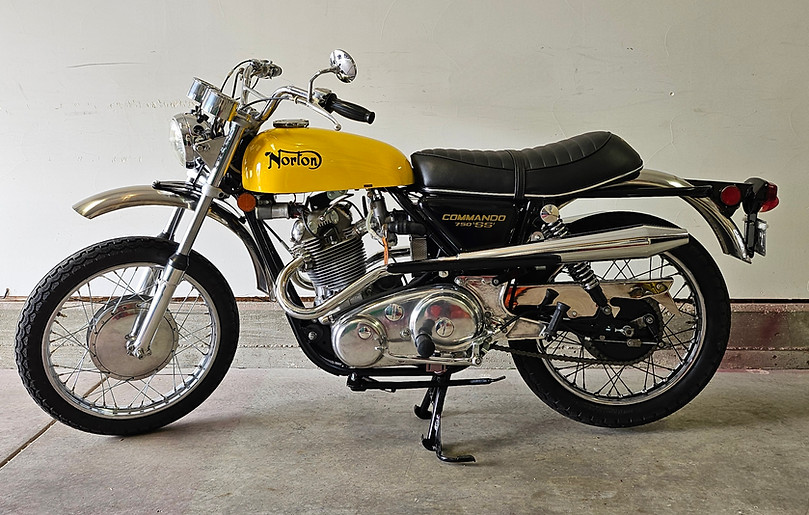
1971 Norton Commando SS
By Mike Hammond
My son Andrew grew up around motorcycles. He actually participated in trials competitions when he was 8 or 9. I was competing also and we had a lot of fun riding together. He rode a Yamaha TY80 and I rode my Penton "Mudlark" in vintage trials events.
As he got older other activities became more important, and the bikes kinda fell by the wayside. Lately he became interested in bikes again and has started collecting various types. English bikes have caught his eye the last couple of years and he now owns 10 or 15.
Yellow is his favorite color so when a "Yellow Peril" Commando appeared on Ebay it became a must have item. The fact that it came in half a dozen cardboard boxes plus a frame was of no consequence 'cause his good ol' Dad will put it all back together again. He has asked me to do about 6-8 projects this last few years.
When we had Andover run the serial number we found out that it was a SS model. The fact that it happened to be shipped in the yellow color choice made it even better. During the late 60's and early 70's the desert racing scene in southern California was at its peak. Think Steve McQueen, Malcolm Smith, "On any Sunday". The English manufacturers wanted a piece of that action. Norton only made the SS for one year (1971), they did not sell very well and Norton only sent 861 to the U.S.A. Many of them were converted to Roadsters by the dealers simply to get rid of 'em. After all who needs a 600 lb. dirt bike with crappy suspension?
After 4 months and many thousands of dollars this project is now complete. The restoration came out pretty good and we will probably take it to a show or two and see if everyone else agrees. I'll ride it to the Saturday morning coffee meet-ups so the club members can see it and go around the block if you want. I've been messin' around with bikes for 60 years and had never seen a SS model.
So enjoy everyone!
(probably never see another)
April
1970 Suzuki T200 Invader
By Sam Whiteside
Hi AMCA Comstockers! Many of you recently visited my garage in Minden and saw one of the bikes that goes farthest into my past, the Suzuki T200. I was able to buy one in 1970 after my friend was the first in our small Northern Ireland town to buy one. Shortly after, another friend bought one. So, we had two red and one black.
Mine soon got modified with alloy wheel rims and an Eddie Crooks fairing. We all took the baffles out of our mufflers to enhance the racing image!
A couple of years later as I planned to leave Northern Ireland, I advertised the bike in the local newspaper. One of the Dunlop racing family bought it as his first bike.
The T200 came onto the US market under a less than flattering ad campaign that was headlined with “Introducing America’s 2nd Best Sportcycle” the Suzuki X5 Invader. The strategy seemed to be capitalizing on the great success of the T20 X6 Hustler 250 or Super 6 if you were in the UK.
I suspect that the Japanese home market may have had capacity restrictions for younger riders. The various ad copy went on to say things like “ the bike that’s better than anywhere you’ve been but still gives you somewhere to grow” and “A Man’s Motorcycle to prove your youth and valor.”
It really was and is a great little bike. Easy to start, easy to ride and the sort that puts a smile on your face. It needs revved between 6-7000rpm to get going, but without a headwind, Motorcycle Mechanics (UK) in 1967 clocked it at 87 mph and Cycle World (US) in 1967 gave it 88mph. Going slightly downhill in 1970 on mine, it reached an indicated 92, before I got scared!
Most of the Hustler developments were included in the T200 except that it was a 5 speed vs 6. The engine was scaled down 50ccs leaving it with 50mm bore and 50mm stroke. I haven’t compared the various engine castings, but they are probably the same with the smaller bore etc. The Posi-Force pumped oil supply to the bearings and bores and was similar to the other 2 stroke manufacturers back then. A great improvement over hand mixing fuel. I always added some Castrol R for the full effect.
It has Mikuni 22mm carbs that are “altitude compensated” by some internal trickery. It rides well in our 4700-6000’ environment. I haven’t tried to take it over Monitor pass though. That would be cruel.
The gearbox will not allow you to shift from 2nd to 1st without going through a hard neutral. So it’s 5,4,3,2,N.1. You won’t get much engine braking anyway. The front twin leading shoe brake is quite good if I compare it to the ones on my old Brit bikes.
The frame is a typical double loop along the lines of the Norton Featherbed that influenced many manufacturers of that time. I was able to find space in the frame to add some old Hella air-horns that get everyone’s attention on the road.
Suzuki quotes 23 bhp which is quite good for the small capacity. Now when I ride, my weight is much higher than when I was 18-20, so it is not the rocket that I remember. With the X6 at 29 bhp, I notice a big difference when I ride the big brother.
The story of the blue one started as a follow up to my purchase of an X6, the red one you may have seen the same day. I decided to look for the rest of the series. From around 1967-70, Suzuki made the T200 Invader, the T20 X6 Hustler, the T305 Raider and the T500 Cobra. I liked the similarity to the existing Brit fashion of chrome tank with rubber side panels and painted oil tanks and battery/toolbox. Right after those 4 bikes, design concepts changed to angular forms and painted tanks. I didn’t find them as pleasing to look at. So, I advertised in the Vintage Japanese Club magazine for a T200 and T500. I was able to buy both at different times from the same person in the eastern US.
The T200 was very rough, but with a little help from a friend, we were able to get it started. It didn’t run too well, probably because it was going backwards. Plug cables needed reversing! It still wasn’t any good, so everything was stripped down, crank sent out for rebuild and new seals and the 100% rebuild all came together in about a year. The worst part was, the complex to me, wiring harness. I don’t have good color vision, so the striped wires were not easy to connect correctly, but I finally got it sorted.
It’s a great little bike! Good for the small bike rides and short get rid of the monkey runs from the garage to nowhere in particular. And it only weighs 270 lb and gets 55 mpg.
Everyone should have one of these. After about 600 miles since completion, it is Nostalgia on wheels. It takes me back to Irish backroads and my youth when I ride it here - except it won’t be raining!

May
1973 Suzuki TS 400 Apache
By Jeff Bannister
My love affair with the Suzuki marque goes back to October 1970, when I bought Cycle World for the first time.
I subsequently discovered my first (Suzuki) heroes, Robert, Geboers, Grant, Nicholas, and Baumann. Not to mention the AMA riders of the day. It was a golden age in my opinion. The motorcycle press was stellar then too. Jennings, Nielsen, Parkhurst, Nicholas, Friedman, et al...
I think it was 2014, I was working and living in the bay area. The bug had bitten, I had already built a 1971 SL350, and was searching Craigslist for maybe a TS250. Don't exactly recall, but saw an ad in Reno, made the drive and bought a decent, complete, running TS400K for $500. in my opinion, K is the most attractive and desirable. Not many were sold, and they are rarely seen these days, a unicorn of sorts. Subsequent models were not as good, particularly the 76/77 iterations. According to Cycle World, 'the best engine in its class'. No lie. It will run with my T500 up to 60-65 mph and is not peaky at all.
I took it home, pulled the motor, and found a local guy, Randy Webber, who had built many TM 400's. The TM was perhaps the biggest black eye ever for Suzuki, or maybe the RE5 takes that honor. He rebuilt the crank, inspected the rest, all was good. The top end looked OK, did some port cleanup, painted the motor and bolted it all back together.
My friend Craig at Top of the Hill Motorsports in Livermore had built a 2 into 1 system for my SL350, and he was tapped again to fix the crushed TS low pipe. His wife, the shop manager, was not happy because he filled his entire shop with old two stroke oil smoke as he cut/heated/hammered/welded the pipe. The end product was/is unbelievable. Looks factory fresh.
Faded cosmetics stayed.
I rode it around for a year or so and it detonated horribly. Finally figured out that it had a TM CDI box. Easy fix. Amazingly, it didn't hole a piston.
And then the triple bug bit. I built 2 H1 Kawasakis, and a CMR framed Hennen TR750/XR11 replica along with an X6 while the TS sat in the corner of my garage until last September. Collected parts in the meantime. Suzuki is to be praised, a lot of interchange/parts bin engineering, it has saved me a lot of pain over the years. Up on the stand it went, completely disassembled it, photos all along the way.
Frame and swingarm etc. went to Armorcoat in Carson City. Excellent job for $250 which was very reasonable.
Chrome went to ABC in Reno including the signature exhaust heat shield. I had a 2nd over modern Wiseco piston in my back pocket. The cylinder went to EdCo in Petaluma for boring. Sanded all the bodywork myself and prowled car lots looking for a modern paint match. Forums yielded nothing but disinformation and Ford velocity blue E7 was finally chosen. Scott at NV Auto Body had painted another project for me and he was tapped again. Repop graphics were obtained from Diablo Cycle/reproduction decals.
Swingarm pivot, fork seals, wheel bearings, brake shoes, and every piece of rubber wasreplaced. Nearly every rubber mount/grommet is still available from Suzuki. The carb was rebuilt. Realized this go-round that it was a 34 mm TM carb and set it up accordingly.
That more or less explains the TM CDI box. Some previous owner tried to hotrod the thing. For sure it's very strong. Oh, and BTW, some of the more successful TM riders of the day put the TS ignition/flywheel on their bikes to tame them. Most notably Rich Thorwaldson RIP. https://www.cyclenews.com/2020/10/article/archives-column-rich-thorwaldson/ Google 'Rich Thorwaldson Suzuki TM400' if you want to read some stories from back in the day.
Anyway, an engine leak down test was performed (wish I knew to do that 50 years ago). Runs better than I remember. Surging is gone, doesn't vibrate much, and with taller gearing it's happy to run down the road at 60+. The only oil that comes out of it is via the tailpipe.
The end result is beautiful, which is a personal thing. Phone photos don't do it justice. All my bikes are drivers, I don't get caught up with polishing hubs and relacing wheels. Too much work and no plus for function. The color is a nearly perfect match. I always loved the early 70s TS styling, as well as the early RMs and the later GS models.
A keeper. Sounds great, goes good, handles and stops as well (on pavement). And it was a pleasure to build, no resistance whatsoever.

June
1943 DKW NZ 350-1
By Rex Reiland
OK......OK.........yes, Rex likes odd motor bikes. So when this DKW came up at Mecum's this year, I hitched a ride with Bob and Sam and went to Vegas. And yes, the man with the hammer took my money. The 1943 DKW NZ 350-1 is an ex-Wehrmacht dispatch rider's bike. This one is an older restoration that came from the Netherlands. DKW was building these bikes before the war and after the war too. The bike runs a 350cc two stroke engine, and a 4 speed transmission with tank and foot shift as required by the army. The 350-1 model changed to an all cast iron engine to save aluminum for the Luftwaffe which makes this a very heavy bike. At over 350 pounds, it was not too good for cross country work. The lighter RT 125 DKW worked better off-road and lots of dispatch rider miles were put on both. The bike is now sporting Afrikakorps tan with equipment. Should be at next year's small bike ride and before.

July
1948 Triumph T100
By Todd Rash and Lynn Boyer
To be fair, this bike belongs to my wife, Robin Rash, and it’s more than just a motorcycle to our family. It’s a legacy. My father-in-law, Lynn Boyer, and I restored it together as a gift for Robin, and we take immense pride in not only keeping it running, but keeping its story alive. We love showing it at AMCA events where it always draws a crowd, not just for how it looks or sounds, but for the history it carries with it.
The Triumph’s known history begins in 1956, when longtime Nevada motorcycle mechanic Melvin “Lee” Wright—affectionately known as “The Guru”—recalled helping move it for its then-owner Bake Stillings, who had opened Nevada Cycle Sales in Sparks, Nevada in 1948. The bike was wheeled down a set of wooden stairs into the basement of the shop’s new location at 817 E. 4th Street in Reno, where it sat for a few years before being relocated to a warehouse around 1960 or 1961, following another shop move to 528 Morrill Avenue. In 1968, when Richard “Dick” Madeira and Richard “Dick” Hammesfahr took over Nevada Cycle Sales, the Triumph surfaced once again. Around 1969, Dick Madeira had Lee Wright service the bike, leaving most of its originality intact except for a repaint of the gas tank in orange. The Triumph remained on display—running and admired—at Nevada Cycle Sales for many years and across multiple locations, including the final move to 2685 Kietzke Lane.
According to Lee, the bike had a flat track racing history in the mid-1950s, piloted by a rider named Jim Darra at various events in northern California. Specific races or results are lost to time, but it's racing spirit lives on in the stories. Another beloved piece of lore tied to this bike involves Dave Shipley—better known at the "Virginia City Grand Prix Phantom". Dressed in a leather aviator jacket, WWI goggles, a leather helmet, and a long flowing white scarf, Shipley would weave through the streets of Virginia City on the Triumph as race announcers shouted, “There goes the Phantom!” When he wasn’t thrilling crowds, Dave was the service manager at Nevada Cycle Sales.
After Dick Madeira’s passing, the bike was passed down to his son-in-law Lynn Boyer, who had since moved to Las Vegas. Lynn brought the Triumph back to street-ready condition and registered it for use. In 1994, Lynn and his wife Rochelle reopened Nevada Cycle Sales in Fallon, Nevada, and the bike once again took its place on showroom display, staying there until 2006. During this time, Lynn modified the Triumph to resemble Dick Mann’s trials configuration, possibly inspired by the 1948 square-barrel ISDT version used in the 1950 event by Mollie Briggs. Lynn campaigned the bike in AHRMA national trials events in the rigid class, competing at Donner, Steamboat Springs, the Sand Bar in Auburn, and more.
After 2006, the Triumph sat in storage until it was passed down to Robin in 2022. That’s when Lynn and I brought it back to life once again, restoring it into the condition you see today. I refinished the gas tank in a color nearly identical to its previous orange hue, and we’ve since shown the bike at the Reno British Car Motor Show and other AMCA motorcycle gatherings. It always draws attention—both for its looks and for its awesome sound.
Beyond its storied past, the 1948 Triumph T100 is notable for its unique mechanical configuration. The square-barrel head and cylinder design were derived from generator units used in WWII Lancaster bombers. After the war, Triumph repurposed this aluminum design into the first postwar T100 models in 1948. At some point in its life, this bike was modified for more aggressive performance: the head was ported, the exhaust redirected with 650 header pipes, and two reverse cone megaphones installed. The original carburetor was replaced with twin Amal GP carbs and a single remote float. The front and rear wheels were replaced with Borrani-style alloy rims, the front hub replaced with a spool hub, and the flat-track bars and solo seat gave it a stripped-down, competition-ready look. The generator was removed and replaced with a spacer, relying instead on a magneto for ignition. The original fuel tank was swapped out for a small, peanut-style aluminum tank.
We’re proud to be the current caretakers of this incredible machine. It’s been passed down through generations of Nevada motorcycle enthusiasts from Dick Madeira to Lynn Boyer, and now to Robin. It’s a bike that was raced, performed, and turned heads for nearly 80 years—and with any luck, it’ll keep doing so for many more.

August
1959 BSA A-10 Super Rocket
By Ted Reite
The story about how I got my 1959 BSA 650 Super Rocket.
A tribute to John Hoy
I moved to Carson City ten years ago, and lucky for me, there was a great park at the end of my street for walking the dog. Walking the dog you meet all kinds of interesting people, and one such person was Doc John. John and I would meet at the park from time to time, and during these times, I got to know him fairly well. As it turned out, we both enjoyed working on and repairing motorcycles.
It was during one of the park visits that I learned he had a shop in southern California and later on in Carson City. One day I asked him if he would rebuild my 1968 BSA 441 Victor Special, and he agreed that he would if I brought him the motor. This worked out great. With some encouragement, two years later he finished the motor. During the engine rebuild it was revealed that John was having trouble remembering some things.
Being in business for several years, John had accumulated a couple of storage units full of motorcycles and parts, and he wanted help selling everything in his storage units. It was about this time that I met Rodd Lighthouse who had coordinated with me to view John’s parts. During Rodd’s visit to the storage sheds, he asked if I needed help helping John liquidate his motorcycles and parts. This was a great help because he has a vast knowledge of motorcycles.
For helping John liquidate he gave me his 1959 BSA 650 Super Rocket. This was his daily ride in the 60's and 70's. John had started restoring the BSA about twenty-five years ago the best l can figure. At that time he had all the chrome redone, rebuilt the wheels with new spooks and rims and assembled a rolling chassis. The transmission was rebuilt with new bearings and gears and was reassembled. The motor was completely rebuilt, but the bottom end was left open to the elements. Luckily, it was stored in N e v a d a. Due to being stored for 25 years and left open to the elements, the engine was full of dust and the bearings were frozen up from old grease. The rest of the parts were in boxes mixed with parts from other motorcycles.
Good thing I am not afraid of a challenge. I completely disassembled the BSA and after spending a year with the BSA spare parts book, I had identified the parts that I had as well as the parts that I was missing and needed to be ordered. I assembled the chassis and installed a new wiring harness. John had previously rebuilt the crank and installed new rods and bearings as well as bored the cylinders and had them sized for a new set of pistons. The motor was taken to Brad Hall to have it checked and assembled.
With the motor back in the frame and finishing the electric, checking the mag, and testing the lights it was time to start the BSA after so many years. I called John to come over to my shop, but did not tell him why. When he came in and saw his bike all back together, he could not believe it. Then, for the first time, I gave it a kick and we had a pop. The next kick, it came to life. John was so happy to see it run after all these years of it sitting on a shelf in storage.
I don't think I will ever sell this bike and I hope my boys and grandkids will keep this piece of history going in the future. This story will be in the box with all the other paperwork I have collected on the BSA.

September
1969 Velocette Thruxton
By Bruce Bousfield
The Velocette Thruxton: Britain’s Last Great Racing Single
For motorcycle enthusiasts with an appreciation for classic British engineering, few names command as much respect as the Velocette Thruxton. Designed as a high-performance evolution of the Velocette Venom, the Thruxton was more than just a road-going machine—it was a thoroughbred racer, hand-built with precision and crafted to dominate endurance racing. Produced from 1965 to 1971 the Thruxton represents the final chapter of Velocette’s racing legacy, and a high-water mark for British single-cylinder motorcycles.
Veloce Ltd was founded in Birmingham, England in 1904 by a German immigrant named Johanne Gutgemann. Johanne changed his name to John Goodman, and in 1928 he changed the marque name to Velocette following the production of a very popular 2 stroke motorcycle called the Velocette.
Thanks to early machines like the KTT the Velocette name had already been well established in racing circles. However, it was the Venom, introduced in 1955, that laid the foundation for what would become the Thruxton. Known for its reliability and refinement, the Venom achieved fame when a factory prepared production model set a 24-hour world speed record in 1961, averaging over 100 mph—a first for a production 500cc bike. It’s worth pondering on that record, imagine any motorcycle in 1961 being run at full throttle for 24 hours and surviving!
During the early 60’s most other racing 500cc singles such as the Manx, Goldstar, and G50 went out of production (and in some cases the companies went bankrupt). During this period the Velocette factory started contemplating a twin engine machine to replace the Venom. At the same time desert racers in California were tinkering with the Venom scrambler trying to extract more power. One of the problems with the Venom engine was that if the engine revved much over 6000 rpm the inlet and outlet valves would “tangle”! So, with considerable welding and machining skills, a head was modified to steepen the valve angle and also enlarge the inlet valve. This proved to be such a success that the California Velocette rep arranged for the cylinder head to be sent to the factory in England where it was received with great interest. At the same time a South African racing team had modified a Venom head to introduce a squish band, which was also received with interest. And so the factory duly fabricated their own cylinder head incorporating these designs. In 1964, this prototype machine won the grueling Thruxton 500 endurance race, beating out factory-backed rivals and proving that their aging single still had what it took. Spurred by this success, Velocette decided to build a limited run of race-ready production machines—and so the Velocette Thruxton was born.
While outwardly similar to the Venom, the Thruxton featured several key performance upgrades. As well as the hand-finished sand cast cylinder head, it had a higher compression piston, a race-spec Amal GP carburetor, a long velocity stack inlet manifold, a race spec Lucas magneto and the crankshaft was balanced for smoother, higher-revving performance.
These refinements brought output to 41 horsepower at 6,200 rpm, with a top speed exceeding 110 mph—impressive numbers for a production pushrod 500cc single. An optional close-ratio transmission also gave racers the flexibility they needed on the track.
Chassis-wise, the Thruxton retained the Venom’s rigid tubular frame but added the front forks from the Venom scrambler which had both compression and rebound damping. A twin leading shoe front brake, clip-on handlebars, rear set footpegs, a bump stop seat and an oil tank cooling grill also emphasized its competition heritage.
The Thruxton wasn’t just a fast road bike, it was a serious contender in real-world racing. Between 1965 and the early ’70s, it was a favorite among privateers and club racers. With a little bit of fettling, the power could be raised to around 50hp and a top speed of 120 mph. In addition to races such as the Isle of Man TT, it was particularly popular at endurance events such as the Thruxton 500, Barcelona 24-Hour, and Bol d'Or. It was also the last British single-cylinder machine homologated for international racing under FIM regulations—a testament to its capabilities.
However, by the late 1960s, the writing was on the wall. Japanese multis were dominating the market with smoother, faster, and more affordable machines. Despite its engineering excellence, the Thruxton was fighting a losing battle. Production ended in 1971 and Veloce Ltd. closed its doors shortly after, marking the end of an era for British single-cylinder racing motorcycles.
With only around 1,108 units ever built, the Velocette Thruxton is now a sought-after collector's bike, prized for its rarity, craftsmanship, and performance heritage.
I was fortunate to pick up a 1969 Thruxton at the Las Vegas Mecum auction in January 2025. It came with a good amount of documented history although its first 18 years in France is somewhat of a mystery. In 1987 it was procured by Simon Goodman (the great-grandson of the founder John Goodman), who returned it to England, restored it and owned it for 8 years. A book called The Velocette Saga was published in 1994 with a photo of Simon and this bike. I have a copy of this book in which Simon has signed the photo! From 1995 to 2024 it was owned by another gentleman in England. He did further restoration work in 1999, but then the bike sat unused until sold through Bonhams auction to a vintage motorcycle dealer in San Francisco. That dealer then sold it at Mecum’s auction to me.
It’s always a bit of a crap shoot when buying a non-running bike at an auction, but I seem to have gotten lucky. After considerable checking over, fluid changes, and various adjustments, it started up and sounded great. However I did discover that the magneto spark was very weak when hot. After getting the magneto rebuilt I discovered that the Amal GP carb was not very practical for street use (no surprise there), and it was quite worn out to boot. So, I replaced the GP carb with a “more modern” 1980’s Amal MkII carb. It now runs great and will even idle! Although rather frustratingly the magneto still has some high temperature issues.
I now have a couple hundred miles on it and it’s a blast to ride. The engine likes to rev, in fact power only comes in strong above 4000rpm. And first gear is incredibly high, I think 60mph at redline, which means pretty slow off the line, but 2nd through 4th feel perfect in the twisties. This is definitely not a town bike, but is fun on the backroads.
But there is no doubting that those were brave men who hurtled around the Isle of Man at over 100 mph on one of these things!

October
1961 BMW R27
By Rocky Phoenix
This months featured motorcycle is my 1961 BMW R27. The smallest of postwar machines produced by BMW. I acquired this bike from a friend of mine in Winnemucca who had not gotten around to restoring it in the 30-40 years he’d owned it. I was looking for a new restoration project as I was just finishing up my 1959 BMW R60 and I thought this would be a fun project to compliment the R60. Perfect for the “small bore” rides; I rationalised to myself! It turns out it was a fun project and has been a joy to ride and own.
The R27 is not commonly seen in the U.S. One reason may be they were expensive for a 250cc bike. Other reasons such as heavy and slow for their class may have contributed to the lack of popularity in the States. The R27 did redeem itself with great reliability and it was durable and easily maintained by their owners. These attributes made the bike much more popular in Europe (Germany), plus tax breaks and easier licensing requirements for 250cc and smaller machines didn’t hurt either.
The R27 evolved from a rigid frame pre-war R23. After the war the Allies initially would only allow BMW to build 250cc or smaller machines, hence the R24 (copy of the R23) was produced to help with cheap transportation for the reconstruction of Germany. The R25 and R26 were steady improvements on the design with the final iteration of this 250cc single being the lovely R27! A long line of the little singles came to an end in 1966. This was the last shaft driven single cylinder motorcycle to be produced by BMW.
I have found the R27 to be very pleasant to ride. This model has a rubber mounted engine that quells engine vibration. The suspension is supple yet firm for good handling. The standard solo seat (spring suspended) is comfortable as well. The front suspension is an “Earles” type fork that by nature is an anti-dive unit. It also has the benefit of being adjustable in trail in the event you want to attach a sidecar! Not many takers on that option as it makes for pretty slow going loaded down!
Starting the R27 is easy. Fuel on, push the “nail” (key) down for ignition, “tickle” the carb (no choke), kick the awkward side kick lever and in 2 kicks or so cold it’s a runner! Controls are familiar to most modern riders, shift on left with down for first and up for the rest. Clutch, brakes and throttle are in the usual places, nothing tricky or special. I will mention that with a 12 pound flywheel the engine takes a bit of time to accelerate and decelerate!
The R27 was thoughtfully appointed with a tool kit, including tire irons, in a separate storage compartment, tire pump, resettable trip meter, locking front forks, hinged rear fender to facilitate rear wheel removal, wheels that were interchangeable with the sidecar and an accessory electrical plug-in socket for your sidecar or trouble light. Not standard (except in Germany) were the turn signals or mirrors.
A delightful small bike for riding in town or slow secondary roads, just don’t plan on getting anywhere fast!

November
1969 Triumph T100C Trophy
By Jerry Meadows
I acquired this bike from the estate of Phil Anderson in 2009. It was one of the fortunate bikes that was in his shed, one step above the weeds outside. It was pretty much complete. I picked it up on the recommendation of British bike guru, Don Harrell, because he said they sounded great.
A T100C denotes skid plate and high pipe – single carbureator. A predecessor to current dual sport machines.
I started the restoration on June 16, 2020. In my usual style, I disassembled everything. Nothing stands out in my mind as to why it had not been completed by Phil other than he may have run out of time. I had the crank balanced and reassembled the engine with all new parts. I was able to use standard bore pistons. I upgraded the front brake to double-leading. I was also able to have the original exhaust system re-chromed. The paint was done by Louis Felez.
I finished the work May 11, 2021 and took it to the Idaho Vintage Motorcycle Show in March of 2022 in Caldwell where it won Best in Class.
To date it is one of the few motorcycles in the collection that I have not started so really don’t know if what Don Harrell said was correct.

December
1961 Matchless G80TCS Typhoon
By Rodd Lighthouse
When I was a teenager, I had the opportunity to purchase a beautiful, rare, Matchless G85CS, a purpose-built machine for desert racing in America. If I remember correctly, I paid $200 for it, and when I say beautiful, I’m not BS’ing. It was super nice with all the correct parts including the AJS 7R magnesium rear hub, center mounted aluminum oil tank, 1 3/8” spigot mounted AMAL GP carburetor, fiberglass tank and side panels, etc. You get the picture, it was sweet.
During those years, I was heavily involved in racing, and although Mom and Dad helped, for the most part, I had to fund my racing exploits. By the time 1983 rolled around, I had advanced to the expert class in motocross and desert racing, and to keep up, I needed a new motorcycle. In 1983, Honda had a program where they offered dealers 4 CR motocross bikes to help sponsor racers and I was offered a new 1983 CR250R. To take advantage of the deal, I had to make the tough decision to sell my Matchless. Racing was great in 1983, the year I won my first and only overall in the desert, but I have always regretted selling my Matchless.
Throughout the years, Dad had several Matchless motorcycles. They were good machines, but they were always sold or traded for reasons that I do not remember.
Dad loved to reminisce and it was not uncommon for him to purchase the same make and model of motorcycle that he had previously owned. The Matchless Competition Scrambles motorcycle is one such machine. I do not remember when Dad purchased the Typhoon, a 600 cc competition scrambles machine, but it remained in his collection until his passing.
Like my father, I also like to reminisce, and when my father passed, I felt like I would like to keep the Matchless in the family. Fortunately, I was able to accomplish that goal, and although it was not the G85CS that I sold 37 years earlier, it was a rare Matchless Competition Scrambles machine, a 1961 Matchless G80TCS. The G80CS and G80TCS were the predecessor to the G85CS, all competition scrambles machines specifically made by Matchless for desert racing in the US. Somewhere between 125 and 300 Typhoons were built between 1959 and 1961 and most were exported to the United States for desert racing.
The history of this machine is unknown, but it was sold to my father as an original. I dispute those claims, but it does possess many original parts, and I think it is bitchin. When I inherited the machine, it was partially disassembled due to an oil leak. I briefly recall that Dad said that it started leaking oil from the oil pump.
Working on liquidating my father’s estate, the Matchless sat in the garage collecting dust until George Canavan had the brilliant idea of an all-English motorcycle exhibit, The British Invasion”, at the National Automobile Museum. Committing the Typhoon to the museum exhibit forced me to reassemble the Matchless for the exhibit, a good thing. After getting her reassembled, I got her to fire with two kicks, but it still needed some work when the exhibition was over. In the process of readying the Matchless for the exhibit, I gave her a bath, not a good thing, which became evident when the exhibit was over, when it was determined that the magneto was a ball of rust behind the point cover. I will work on it this winter and hope to have it running for some spring riding. Until then, I will look forward to my first ride on a Matchless in several years.
